How to Choose a Water Filter: A Practical Buying Guide
Recommended picks


Understand the Filter Types
Replacement water filters (the cartridge style used in refrigerators and under-sink systems) are the most common purchase, and they vary widely in what they are designed to do. Pitcher filters sit on your countertop and are convenient but slow, typically processing only 40 to 150 gallons before needing a replacement. Faucet-mount filters attach directly to your tap and offer on-demand filtered water without plumbing work. Under-sink and reverse osmosis systems deliver higher flow rates and, in the case of RO, can reduce dissolved solids that simpler carbon filters leave behind. Refrigerator replacement cartridges, like the Waterspecialist WS627B (4.7 stars across 31,300 reviews, $27.99 for a 3-pack, NSF 42 certified), are the easiest swap and the most widely purchased category. Knowing which type fits your kitchen setup before you compare prices saves a lot of wasted time.
Read the NSF Certifications
NSF International certifications tell you exactly what a filter has been independently verified to reduce, and they are the most reliable signal on any product listing. NSF 42 covers aesthetic concerns such as chlorine taste, odor, and particulates. NSF 53 is designed to reduce health-related contaminants including certain levels of lead, cysts, and volatile organic compounds. NSF 401 addresses emerging contaminants such as pharmaceuticals and pesticides. NSF 372 confirms that the materials used are lead-free. The Waterdrop WDP-F03 (4.7 stars, 787 reviews, $19.89, certified to NSF 42, 53, 401, and 372) is a good example of a filter that carries the full set of certifications, which gives you broader coverage for the price. IAPMO and WQA Gold Seal are equivalent third-party certifications, so a filter carrying those marks has gone through a comparable verification process. Avoid any filter that only claims to be "NSF-standard" or "equivalent to NSF" without a listed certification number.
Match Compatibility Before You Buy
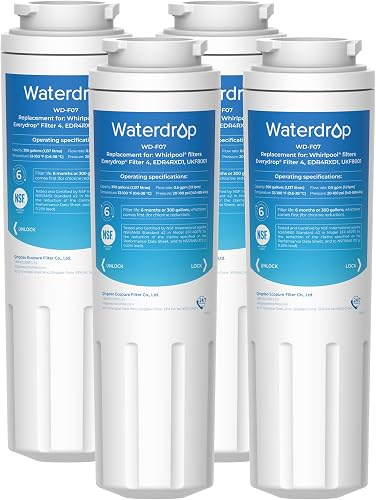
Refrigerator replacement filters are model-specific, and installing the wrong cartridge can result in leaks, no water flow, or an indicator light that never resets. Check your fridge's owner manual or the sticker inside the filter housing compartment for the OEM part number, then confirm the third-party filter you are considering lists that number as a compatible fit. The Waterdrop WD-F07 (4.8 stars across 6,767 reviews, $35.69 for a 4-pack, NSF certified) is one of the higher-rated options in this category and its listing covers a specific range of compatible models. For under-sink and faucet filters, check thread size and water line diameter before ordering. A quick compatibility check takes two minutes and avoids a return shipment.
Calculate True Cost Per Gallon
The sticker price on a filter cartridge is only part of the story. Divide the cost of the filter by its rated capacity in gallons to get the real cost per gallon. A $30 filter rated for 300 gallons costs 10 cents per gallon; a $20 filter rated for 100 gallons costs 20 cents per gallon despite looking cheaper at the shelf. Multi-packs almost always lower the per-gallon cost: a 3-pack at $27.99 covering the same capacity as three single units at $14.99 each means the 3-pack saves you real money over a year. Factor in replacement frequency too, since a filter rated for 6 months costs roughly twice as much to run annually as one rated for 12 months at the same per-filter price. Doing this math once per purchase decision keeps annual costs predictable.
Consider Installation Requirements
Refrigerator cartridges require no tools and no plumbing: twist or push to swap, then run two to three gallons of water through to flush the new filter. Faucet-mount filters attach in minutes with hand-tightening and typically include adapters for standard faucet threads. Under-sink systems need a water line shutoff, a feed saddle valve or T-fitting, and a dedicated faucet hole in your sink or countertop. Reverse osmosis systems add a holding tank and a drain connection, so installation is more involved and usually benefits from a licensed plumber if you are not comfortable with basic plumbing. Whole-house systems require a main line bypass valve and may need a permit depending on your municipality. Be honest about your comfort level before you commit to a system that needs a professional install.
Plan for Filter Replacement
Every filter has a rated service life based on a combination of time and gallons processed, and using a filter past its capacity means contaminant reduction drops off while flow rate decreases. Most refrigerator filters are rated for 6 months or 200 to 300 gallons, whichever comes first. If your household uses the fridge dispenser heavily, you may hit the gallon limit before the 6-month mark. Set a calendar reminder on the day you install a new filter rather than relying on a fridge indicator light, which can be imprecise. Keeping one spare filter on hand means you are never drinking from an overdue cartridge while waiting for shipping. Factor the annual replacement cost into your total appliance budget when comparing systems.
Common mistakes to avoid
- Buying a filter based on brand name alone without checking whether it carries an actual NSF, IAPMO, or WQA certification for the contaminants you care about.
- Skipping the compatibility check and ordering a refrigerator cartridge that does not list your fridge model, then discovering it leaks or does not seat properly.
- Comparing only the per-filter price without dividing by rated capacity, which makes a cheap but short-lived filter look like a better deal than it really is.
- Assuming any filter will remove lead or other health-related contaminants when only filters certified to NSF 53 or equivalent have been verified to reduce those specific contaminants.
- Running a refrigerator or pitcher filter well past its rated life under the assumption the water still tastes fine, when taste is not a reliable indicator that the filter is still performing.
- Choosing a whole-house or under-sink RO system based on marketing claims without first checking your local water quality report to confirm that level of filtration is actually needed.
Frequently asked questions
What does NSF 42 vs NSF 53 mean for a water filter?
NSF 42 certification means a filter has been independently verified to reduce aesthetic contaminants, primarily chlorine taste, chlorine odor, and particulates. NSF 53 goes further and covers health-related contaminants including lead, certain cysts, and volatile organic compounds. If your main concern is taste or odor, an NSF 42 filter is sufficient. If your water test or local report shows elevated lead or other health contaminants, look specifically for NSF 53 certification.
How often should I replace my water filter?
Most refrigerator replacement filters are rated for 6 months or 200 to 300 gallons, and you should replace at whichever limit you hit first. High-use households may reach the gallon limit in less than 6 months. Pitcher filters typically need replacement every 40 to 150 gallons depending on the brand and model. Under-sink carbon filters are usually rated for 6 to 12 months, while RO membranes can last 2 to 3 years. Always follow the manufacturer's rated capacity rather than relying on taste alone.
Is a third-party replacement filter as good as the OEM filter?
A third-party filter that carries a legitimate NSF, IAPMO, or WQA certification for the same contaminant categories as the OEM version has been independently verified to perform to that standard. Certification is the key indicator, not brand origin. Third-party filters from certified brands like Waterspecialist, Waterdrop, or Aqua Crest typically cost significantly less per filter than the original manufacturer's version while meeting the same performance benchmarks. Always confirm compatibility with your specific model number before purchasing.
Do I need a whole-house filter or is a point-of-use filter enough?
For most households on city municipal water, a point-of-use filter at the refrigerator, faucet, or under-sink location handles the primary concerns of taste, odor, and common contaminants. Whole-house filters make more sense if you have well water with sediment or high iron levels, or if you want protection at every tap including showers. They add cost and require more maintenance. A water test or your local utility's annual quality report is the best starting point for deciding how much filtration your situation actually requires.
Can I contact AquaGroove with questions about specific filters?
Yes. Reach us at [email protected] and we will do our best to point you toward the right information. We are not water treatment professionals or licensed plumbers, so for complex water quality issues or whole-home installation questions, we recommend consulting a certified water treatment specialist in your area.